

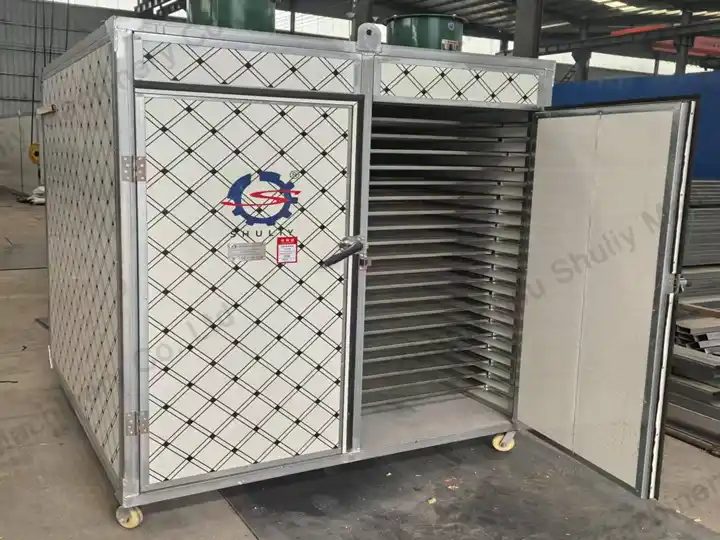
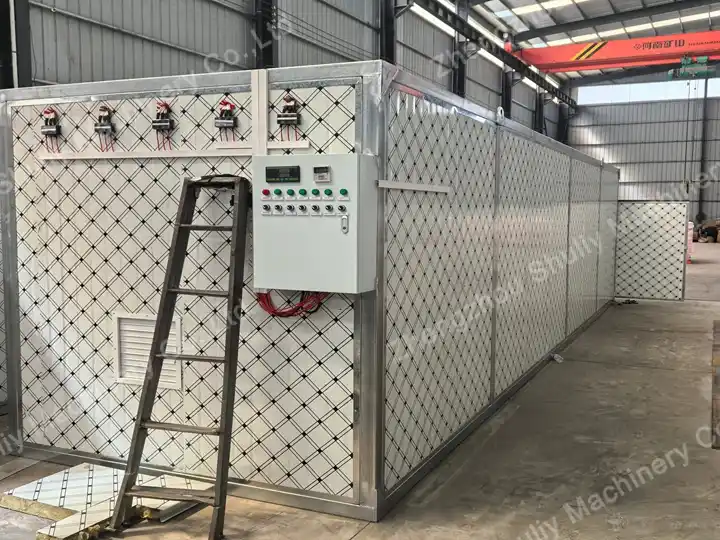
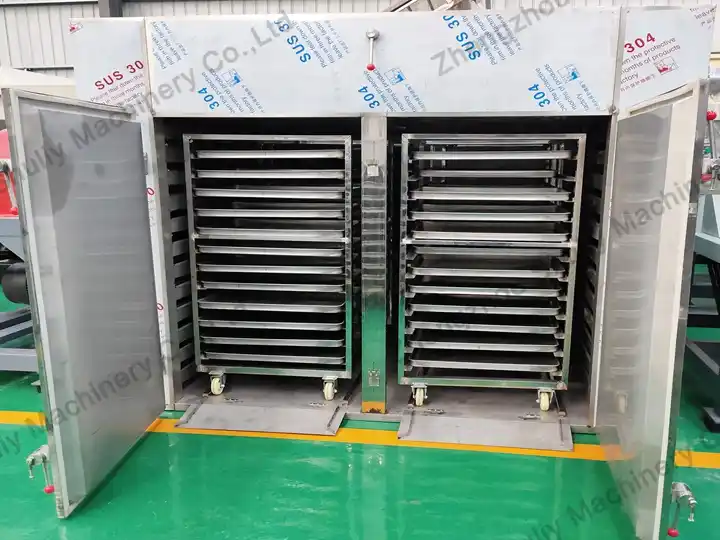
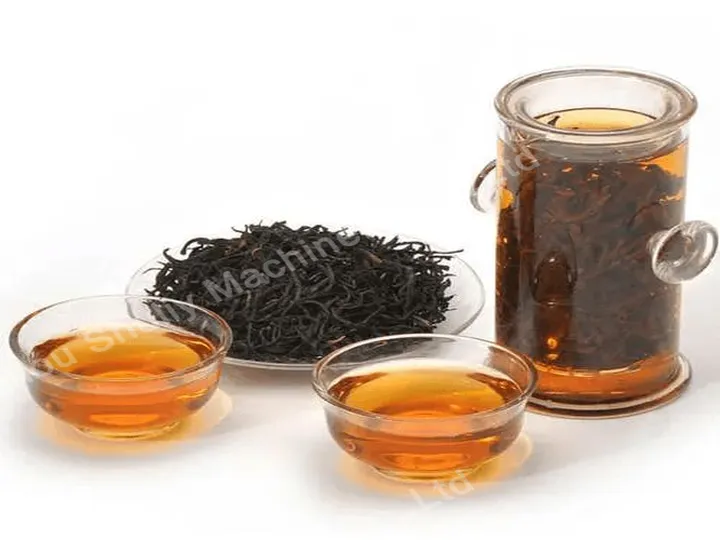
Yang black tea drying machine is a closed-chamber batch dryer designed to stop fermentation and reduce moisture in fully oxidized black tea leaves. It processes 300–8,000 kg of fermented tea per batch. Freshly fermented leaves enter at 55–65% moisture. The system reduces this to 3–5% within 2–4 hours. Dried black tea is ready for grading, sorting, and packaging for domestic sale or export.
Conventional charcoal-fired dryers run at 100–120°C with no humidity control. This black tea dryer operates at 70–105°C in a sealed chamber with ±1°C temperature precision. The heat pump recycles thermal energy from exhaust air. It delivers a COP of 3.0–4.0. Electricity consumption drops by 60–70% compared to direct electric heating. A PLC touchscreen lets operators program multi-stage drying profiles. Chamber temperature stays within ±1°C. Relative humidity stays within ±3%. The 2–4 hour cycle enables 4–6 batches per day during peak harvest.
Shuliy has manufactured industrial drying equipment for over 20 years. The company has exported heat pump dryers to more than 30 countries. All chambers use 304 stainless steel trays. Housing options include galvanized steel and SUS304. The system meets EU and FDA food-contact material standards. A 12-month warranty covers all mechanical and electrical components. Lifetime technical consultation is included.
Why Must Black Tea Be Dried?
After full fermentation, black tea leaves still contain 55–65% moisture and active enzymes. Without timely and controlled drying, quality deteriorates rapidly.
- Over-Fermentation: Enzymatic activity continues. The tea develops a sour, overripe flavor. Astringency increases. Market grade drops.
- Color Degradation: Uncontrolled moisture causes uneven oxidation. Leaf color turns dull brown instead of the desired dark amber. Buyers reject discolored batches.
- Mold Growth: Moisture above 8% creates ideal conditions for Aspergillus and Penicillium mold. Aflatoxin contamination becomes a food safety risk.
- Aroma Loss: Volatile aromatic compounds evaporate unevenly. The characteristic malty, floral, or fruity notes fade. Tea loses its premium classification.
The Shuliy black tea drying machine solves these problems through staged temperature control. A three-phase drying profile stops fermentation at the optimal point. Moisture draws evenly from each leaf. Aroma compounds are locked in. The final product reaches 3–5% moisture with batch uniformity within ±0.5%.
Apa Itu Mesin Pengering Teh Hitam?
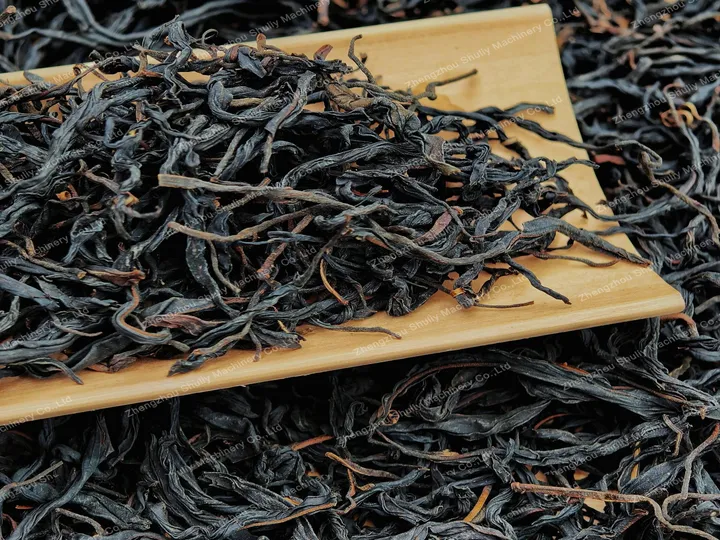
Mesin pengering teh hitam adalah alat pengedaran udara panas yang direka khusus untuk mengeringkan teh hitam yang telah menjalani penapaian. Daun teh disusun secara sekata di atas dulang dan dikeringkan secara berperingkat dengan udara panas yang boleh dikawal, mencapai pengeringan yang stabil dan cekap.
Berbanding kaedah pengeringan matahari tradisional atau memanggang manual, pengering teh hitam menawarkan kelebihan yang jelas:
- Suhu terkawal, kurang terpengaruh oleh persekitaran
- Pemprosesan secara pukal untuk kecekapan pengeluaran yang lebih tinggi
- Kualiti stabil, sesuai untuk pengeluaran berstandard
- Mengurangkan kos buruh dan kebergantungan kepada pengalaman
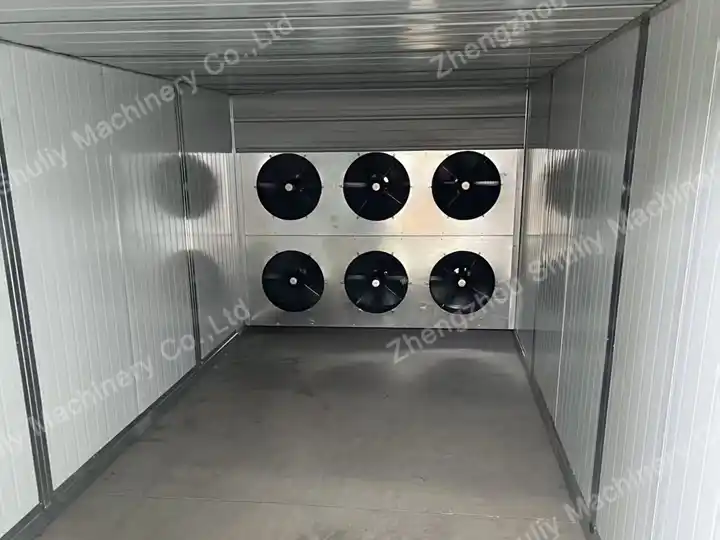
Spesifikasi Teknikal
| Parameter | Spesifikasi | Nilai Pelanggan |
|---|---|---|
| Julatan Model | SL-2 hingga SL-24 | 8 models from 300–8,000 kg for precise capacity matching |
| Kaedah Pengeringan | Pam Haba Sumber Udara | 70% energy savings versus electric heating; zero combustion emissions |
| julat Suhu | 30–110°C (adjustable) | 70–105°C optimal for black tea; stops fermentation without scorching |
| Control Precision | ±1°C temperature; ±3% RH humidity | Prevents over-drying and under-drying within the same batch |
| Kapasiti Kumpulan | 300–8,000 kg fermented tea | Scales from small tea estate to industrial export volume |
| Drying Cycle | 2–4 hours/batch | 4–6 batches per day during peak harvest season |
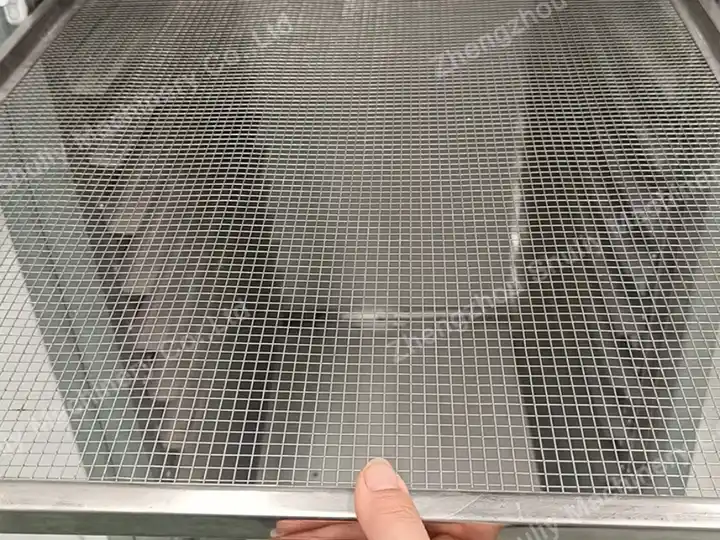
| Bahan Dulang | 304 stainless steel (perforated) | Food-grade, corrosion-resistant, easy to clean |
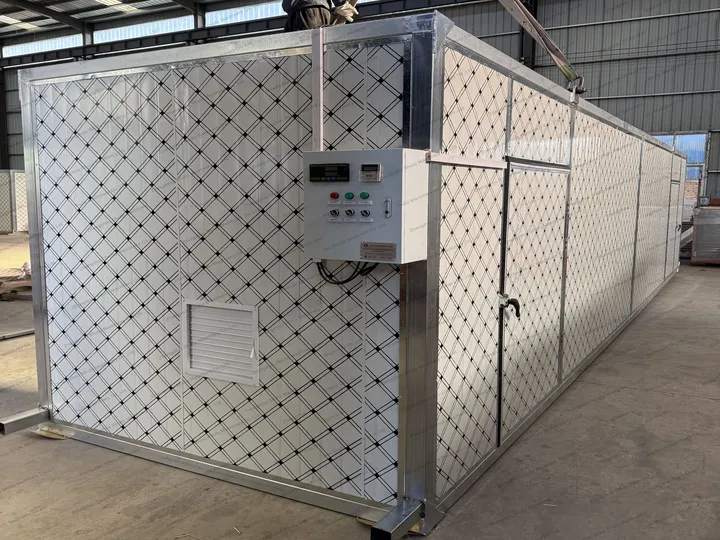
| Chamber Construction | Galvanized steel or SUS304 | 75 mm rock wool insulation; durable frame |
| Sistem Kawalan | PLC with HMI touchscreen | Automated profiles reduce labor and human error |
| Kelembapan Akhir | 3–5% | Optimal for grading, packaging, and 24-month storage |
| Penggunaan Kuasa | 3–36 kW (model dependent) | Low operating cost; suitable for rural tea estate power supply |
| Penebat | Wool batu suhu tinggi 75 mm | 20% energy efficiency improvement over uninsulated chambers |
Model Selection Guide
| Model | Dimensions (mm) | Drying Crews | Kapasiti (kg/siri) |
|---|---|---|---|
| SL-2 | 4,000 × 1,860 × 2,500 | 2 | 300–600 |
| SL-4 | 6,000 × 1,860 × 2,500 | 4 | 500–1,000 |
| SL-6 | 7,200 × 2,300 × 2,500 | 6 | 800–1,500 |
| SL-8 | 8,500 × 2,300 × 2,500 | 8 | 1,000–2,000 |
| SL-10 | 10,000 × 2,300 × 2,500 | 10 | 1,200–2,500 |
| SL-12 | 8,500 × 3,300 × 2,500 | 12 | 2,500–4,000 |
| SL-18 | 8,500 × 5,000 × 2,500 | 18 | 4,000–6,500 |
| SL-24 | 12,000 × 5,000 × 2,500 | 24 | 5,000–8,000 |
How Does the Black Tea Dryer Work?
Yang black tea dryer uses a hot-air circulation system, allowing heated air to flow evenly throughout the drying chamber. This continuous airflow removes moisture from the tea leaves, achieving controlled drying.
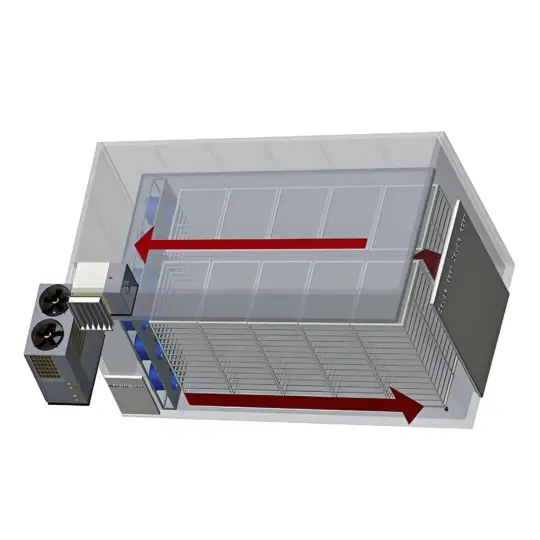
1. Evaporation Stage
Ambient air passes across the evaporator coil. Refrigerant absorbs thermal energy. The air is pre-cooled.
2. Compression Stage
The compressor raises refrigerant temperature and pressure. A high-grade heat source is created.
3. Condensation Stage
Hot refrigerant circulates through the condenser coil inside the drying chamber.
Circulated air heats to the setpoint temperature of 70–105°C.
4. Dehumidification Stage
Warm, moist air passes over the evaporator coil.
Water vapor condenses into liquid. The condensate drains from the system.
The dry air is reheated and recirculated.
5. Control Stage
PLC sensors monitor temperature, humidity, and airflow.
Compressor speed, fan velocity, and exhaust damper position adjust in real time.
The energy-recovery design produces 3–4 kW of usable heat per 1 kW of electrical input.
Conventional electric dryers produce only 1 kW of heat per 1 kW of input.
Black Tea Drying Process: Step by Step
1. Feeding and Spreading
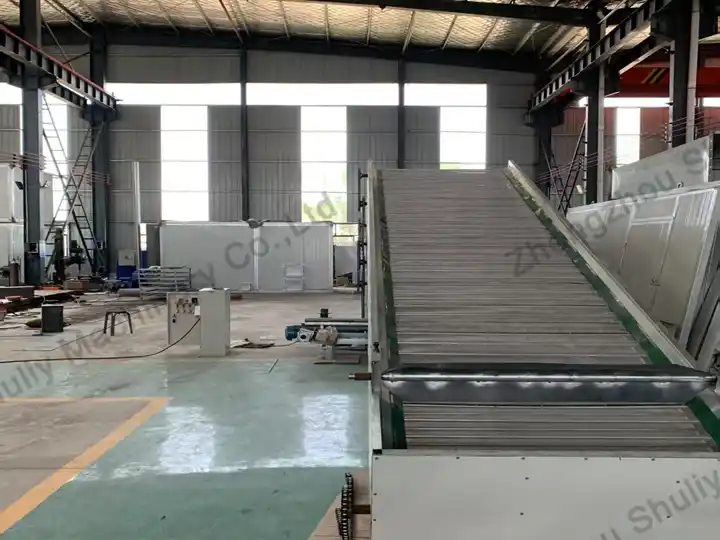
- Fully fermented black tea leaves are evenly spread on drying trays or conveyor belts to ensure uniform heating.
2. Hot-Air Heating and Circulation
- The heating system (electric, gas, or biomass) heats the air, and fans circulate the hot air throughout the drying chamber to avoid local overheating.
3. Staged Temperature-Controlled Drying
- Pengeringan Awal (80–90°C): Dengan cepat menghilangkan kelembapan permukaan dan mencegah daun melekat.
- Pengeringan Utama (90–105°C): Pengeringan sekata, menetapkan struktur aroma dan rasa.
- Pengeringan Akhir (70–85°C): Mengstabilkan kandungan kelembapan tanpa merosakkan aroma.
4. Moisture Exhaust and Air Exchange
- Moist, hot air is expelled through the exhaust system while fresh air enters, maintaining a stable drying environment. The final moisture content is generally controlled at ≤5%.
5. Discharge and Cooling
After drying, tea leaves are discharged and cooled naturally or with assistance to prevent reabsorption of moisture.
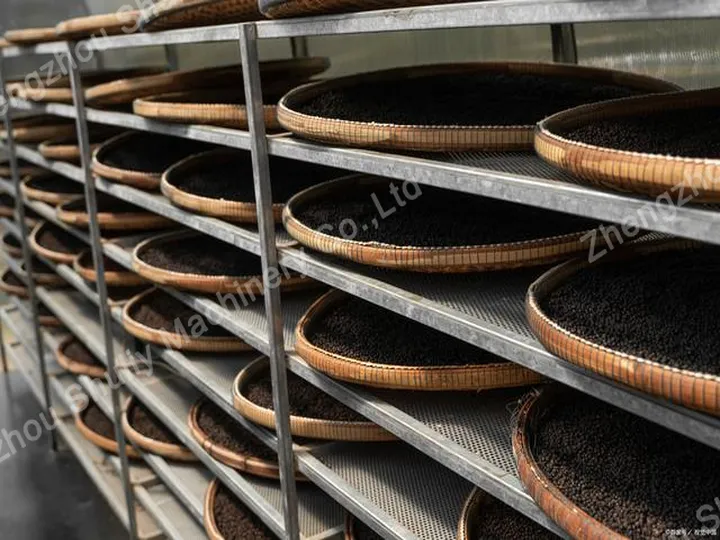
Kelebihan Utama Menggunakan Mesin Pengering Teh Hitam
Pengeringan Seragam
Daun teh dipanaskan secara sekata, memastikan warna dan rasa yang konsisten.
High Efficiency and Controllable Capacity
Sesuai untuk kilang teh kecil hingga pengeluaran berskala besar.
Multiple Heat Source Options
Boleh menggunakan pemanasan elektrik, gas, atau biojisim, menyesuaikan dengan keadaan tenaga tempatan.
Easy Operation and Maintenance
Sesuai untuk pengeluaran berterusan dan penggunaan jangka panjang.
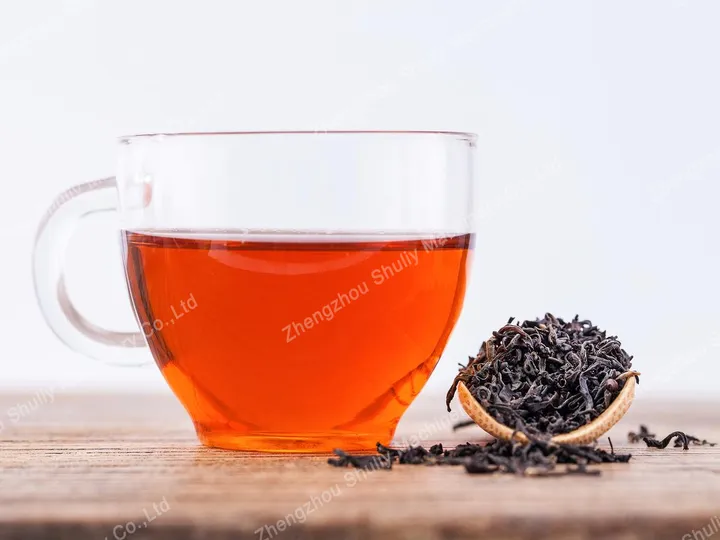
Senario Penggunaan Mesin Pengering Teh Hitam
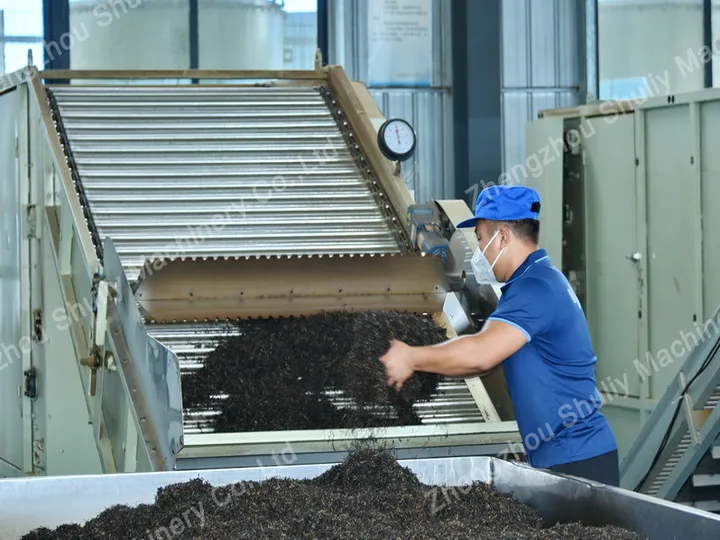
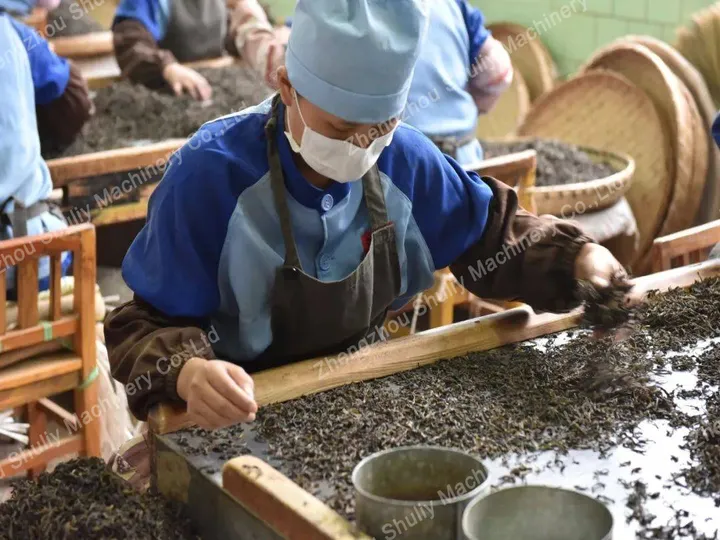
Pengering teh hitam digunakan secara meluas untuk:
- Memproses teh daun utuh dan teh pecah (CTC)
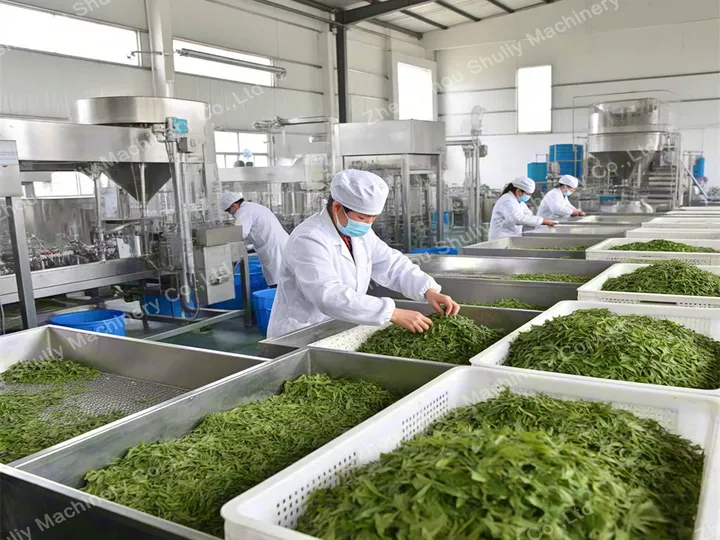
- Pengeluaran teh di kilang kecil hingga sederhana
- Perusahaan pemprosesan teh hitam berorientasikan eksport
- Barisan pengeluaran teh hitam berskala kecil hingga besar
Bagaimana Memilih Mesin Pengering Teh Hitam yang Sesuai?
When selecting a black tea drying machine, it is recommended to focus on:
- Kapasiti pemprosesan berkelompok atau setiap jam yang diperlukan
- Jenis sumber haba yang tersedia
- Ruang dan susun atur bengkel
- Keadaan suhu dan kelembapan tempatan
Memilih model yang sesuai bukan sahaja dapat meningkatkan kecekapan pengeringan tetapi juga dapat mengurangkan penggunaan tenaga dan kos operasi secara berkesan.
Bagaimana Membuat Teh Hitam?
Plucking
- Pilih daun teh lembut dengan satu mata dan satu atau dua helai untuk memastikan kualiti bahan mentah.
Withering
- Menggunakan penyebaran semula secara semula jadi atau bilik pengeringan yang dikawal suhu dan kelembapan untuk mengurangkan kelembapan dan melembutkan daun, menyediakan mereka untuk digulung dan penapaian.
Rolling
- Memecahkan sel daun untuk melepaskan jus, membentuk jalur atau daun pecah, yang mempromosikan pengoksidaan polifenol.
Penapaian
- Menapaikan daun sepenuhnya di bawah suhu dan kelembapan yang sesuai, mengubah warna dari hijau ke merah dan membangunkan aroma serta rasa unik teh hitam.
Pengeringan
- Gunakan bilik pengeringan atau pengering udara panas untuk menghentikan penapaian, mengurangkan kandungan kelembapan kepada ≤5%, dan menetapkan aroma serta rasa.
Grading
- Mengklasifikasi teh berdasarkan jalur daun, daun pecah, dan penampilan untuk memastikan keseragaman dan kualiti yang stabil.
Pembungkusan
- Menutup rapat teh yang dikeringkan dan diklasifikasi untuk mengelakkan kelembapan dan bau, menjadikannya sesuai untuk penyimpanan dan pengangkutan.
Shuliy menawarkan pelbagai mesin pengering teh hitam dalam bahan keluli tahan karat dan bahan standard, semuanya boleh disesuaikan. Untuk maklumat lanjut, sila hubungi kami.
Solving Common Black Tea Drying Challenges
| Customer Pain Point | Penyelesaian Shuliy | Result |
|---|---|---|
| Over-fermentation from slow drying | Staged temperature profile (80°C → 105°C → 70°C) | Enzymatic activity stopped within 20 minutes; flavor locked in |
| Uneven moisture causing mold in storage | 360° turbulent airflow and automated humidity exhaust | Batch uniformity within ±0.5% moisture deviation |
| Aroma loss from excessive heat | Final drying phase at 70–85°C with controlled exhaust | Volatile compound retention above 90%; premium grade maintained |
| High fuel costs from charcoal or biomass | Heat pump COP 3.0–4.0 with energy recovery | 60–70% reduction in drying energy cost per kg |
| Seasonal harvest peaks overwhelming capacity | Modular SL-series from 300–8,000 kg; 2–4 h cycles | 4–6 batches per day; multi-chamber expansion available |
| Export rejection due to moisture non-compliance | Precise 3–5% final moisture with PLC verification | Full compliance with ISO 3720 and buyer specifications |
Why Choose Shuliy Black Tea Drying Equipment?
- Proven Heat Pump Technology: Thousands of installed drying rooms across agricultural and food processing sectors. System reliability is validated in real-world conditions.
- Application-Specific Expertise: Drying protocols for orthodox whole-leaf, CTC, and broken black tea are pre-programmed into the PLC. Commissioning time is reduced. Operator training is simplified.
- Full Material Traceability: All stainless steel components carry mill test certificates. Chamber insulation meets fire-rating and thermal-conductivity standards for international export.
- Integrated Processing Lines: Shuliy supplies withering troughs, rolling machines, fermentation chambers, and grading sorters. Turnkey black tea processing projects are supported.
- Global Export Experience: CE-certified electrical systems. Multi-voltage compatibility (220V/380V/415V/460V). ISPM-15 compliant export packing ensures smooth customs clearance.