
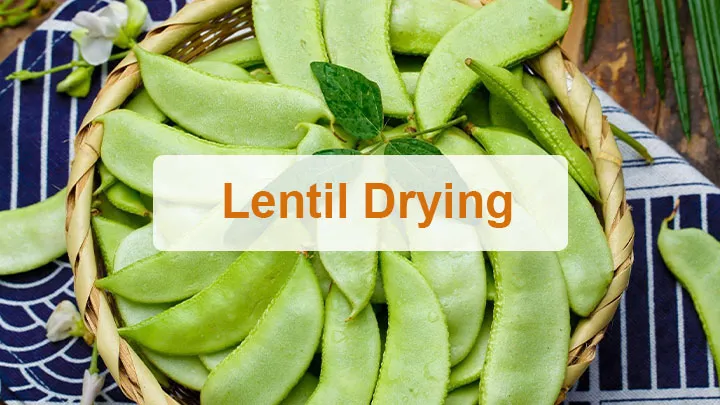
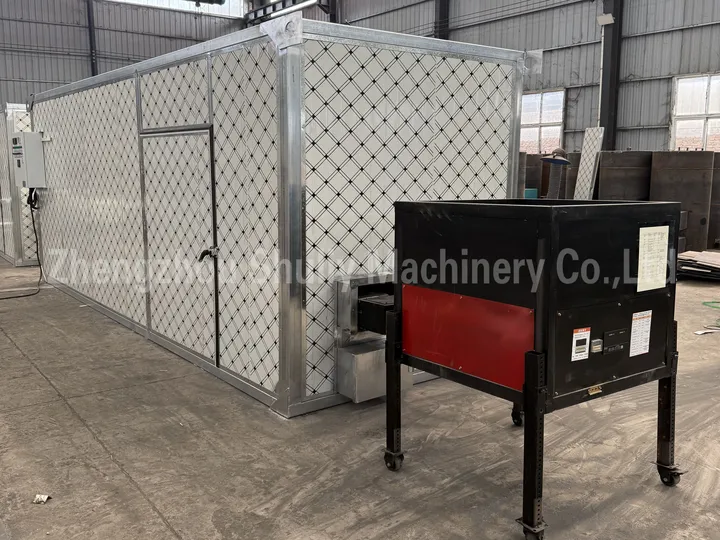
Các lentil drying machine is a closed-chamber batch dryer built around an air-source heat pump system. It processes 300–8,000 kg of lentils per batch. Lentils enter at 13–15% moisture. The system reduces this to 5% within approximately 6 giờ. Dried lentils are ready for storage, packaging, milling into flour, or further processing into protein isolates and split lentil products.
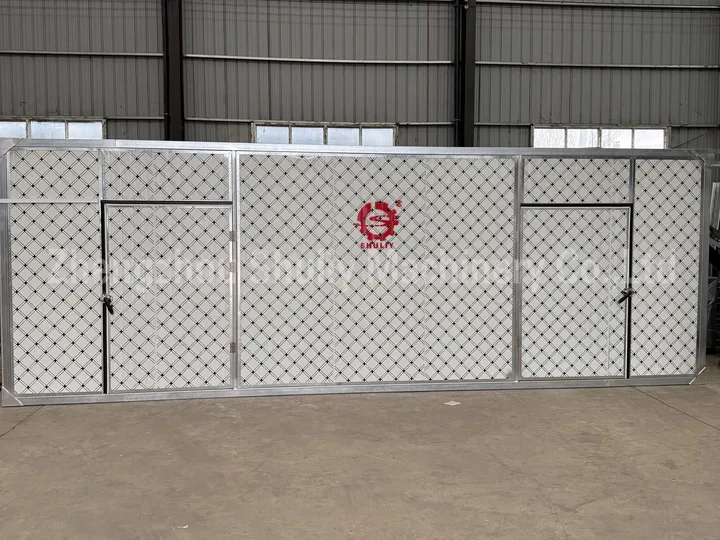
Conventional sun drying takes 3–7 days. It exposes lentils to dust, insects, and rain damage. This lentil dryer operates at 50–65°C in a sealed chamber. The heat pump recycles thermal energy from exhaust air. It delivers a COP of 3.0–4.0. Electricity consumption drops by 60–70% compared to direct electric heating. A PLC touchscreen lets operators program drying profiles. Chamber temperature stays within ±1°C. Relative humidity stays within ±3%. The 6-hour cycle enables 3–4 batches per day.
Shuliy has manufactured industrial drying equipment for over 20 years. The company has exported heat pump dryers to more than 30 countries. All chambers use 304 stainless steel trays. Housing options include galvanized steel and SUS304. The system meets EU and FDA food-contact material standards. A 12-month warranty covers all mechanical and electrical components. Lifetime technical consultation is included.
Note before reading: If you are interested in the machine featured in this article, please click the three contact options on the right-hand pop-up window to get in touch with us. We will provide you with a quotation within 24 hours.
Why Does a Lentil Drying Machine Require Precision Moisture Control?
Lentils are a high-protein legume. They contain 24–26% protein, 60–65% carbohydrates, and less than 1% fat. These nutritional properties make them a staple food in over 120 countries. But they also create specific drying challenges.
- Cracking Risk: Lentils with moisture above 14% develop micro-cracks during rapid drying. Cracked lentils lose market value. They also cook unevenly.
- Color Degradation: Temperatures above 70°C cause browning. The green or red color fades. Buyers reject discolored batches.
- Storage Stability: Lentils above 12% moisture attract weevils and mold. Storage life drops from 24 months to under 6 months.
- Splitting During Milling: Uneven moisture causes inconsistent splitting. Whole lentils break into irregular fragments. Flour yield drops by 8–12%.
The Shuliy lentil drying machine solves these problems through controlled heat pump drying. Air circulates at 50–65°C. Humidity is managed within ±3% RH. Moisture draws evenly from each lentil. The seed coat remains intact. Color is preserved. The 6-hour drying cycle brings lentils from 13–15% down to 5% with batch uniformity within ±0.5% moisture deviation.
Who Needs a Lentil Drying Machine?
- Lentil Processors and Millers: Achieve 5% moisture for safe long-term storage. A single SL-6 unit (800–1,500 kg/batch) handles the output from 15–25 tons of harvested lentils.
- Pulse Exporters: Meet international moisture standards (below 14% for most import regulations). Uniformly dried batches pass phytosanitary inspections without rejection.
- Split Lentil (Dal) Producers: Even moisture ensures clean splitting. Whole lentils separate into uniform halves. Breakage rate drops below 3%.
- Lentil Flour Manufacturers: Consistent moisture produces uniform particle size during milling. Flour yield increases by 8–12% compared to unevenly dried raw material.
- Agricultural Cooperatives: Dry lentils immediately after harvest. An SL-4 unit (500–1,000 kg/batch) prevents post-harvest losses that reach 15–20% with sun drying.
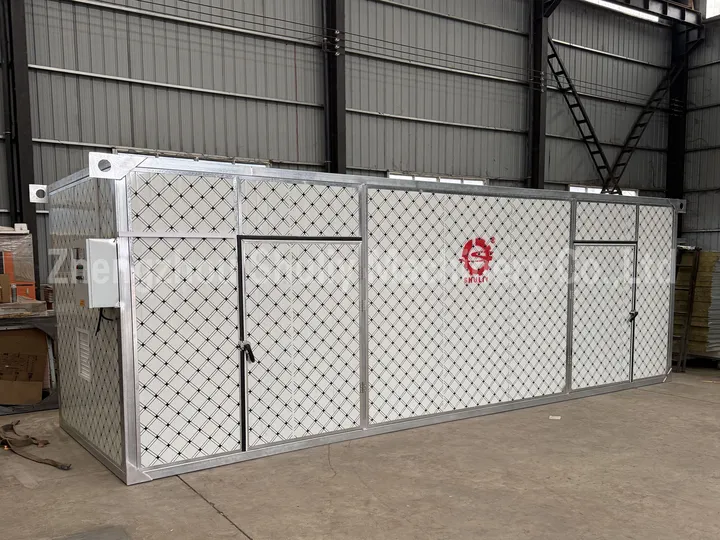
Thông số kỹ thuật
| Thông số | Thông số kỹ thuật | Giá trị khách hàng |
|---|---|---|
| Phạm vi mẫu mã | SL-2 đến SL-24 | 8 models from 300–8,000 kg for precise capacity matching |
| Phương pháp sấy | Bơm nhiệt nguồn khí | 70% energy savings versus electric heating; zero combustion emissions |
| Phạm vi nhiệt độ | 30–80°C (adjustable) | 50–65°C optimal for lentils; preserves color and prevents cracking |
| Control Precision | ±1°C temperature; ±3% RH humidity | Prevents over-drying and under-drying within the same batch |
| Dung tích lô | 300–8,000 kg fresh lentils | Scales from small cooperative to industrial export volume |
| Drying Cycle | ~6 hours (13–15% to 5%) | 3–4 batches per day; fast turnaround |
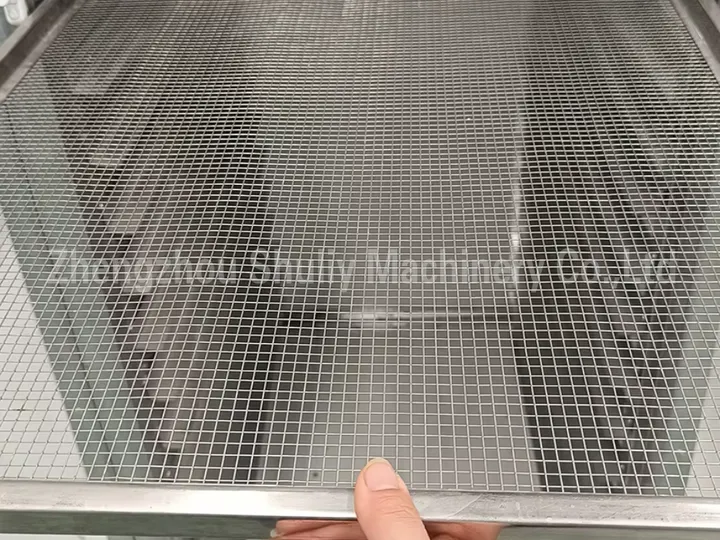
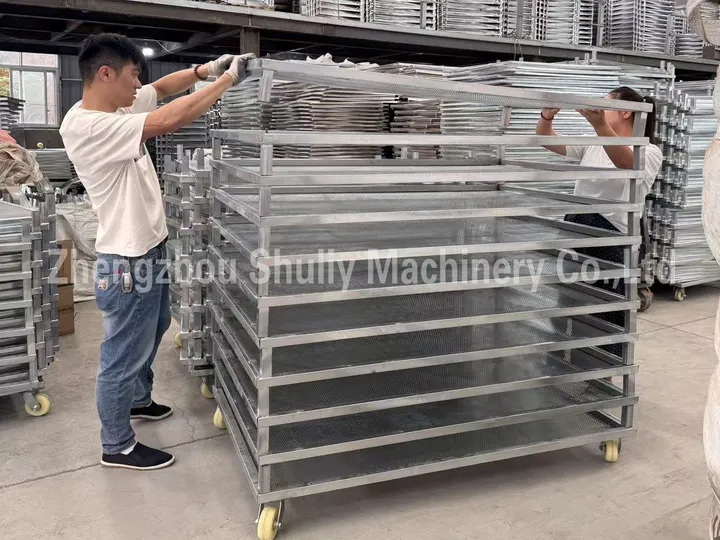
| Chất Liệu Khay | 304 stainless steel (perforated) | Food-grade, corrosion-resistant, easy to clean |
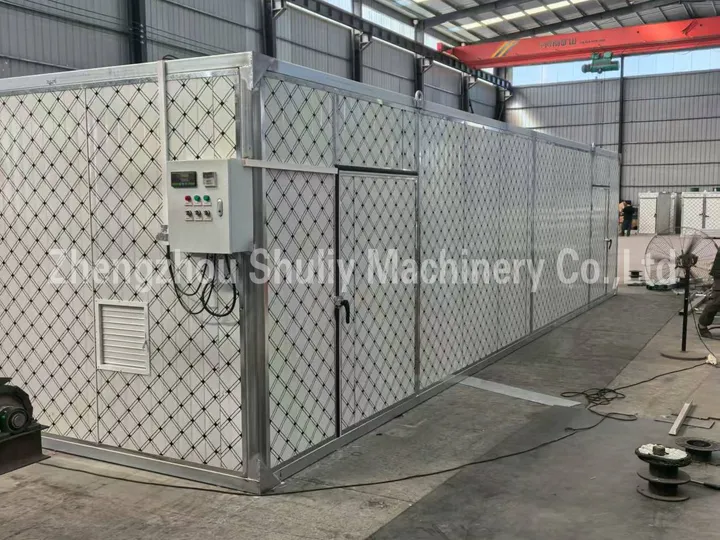
| Chamber Construction | Galvanized steel or SUS304 | 75 mm rock wool insulation; durable frame |
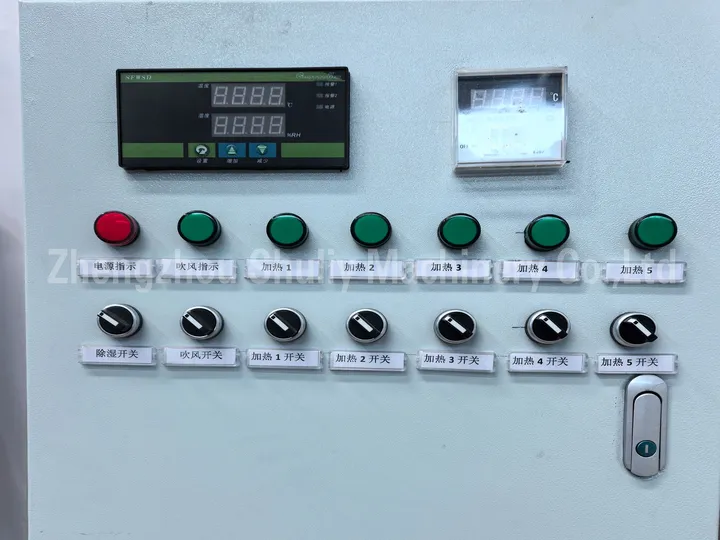
| Hệ thống điều khiển | PLC with HMI touchscreen | Automated profiles reduce labor and human error |
| Độ ẩm cuối cùng | 5% | Optimal for storage, milling, splitting, and export |
| Tiêu thụ điện năng | 3–36 kW (model dependent) | Low operating cost; suitable for rural power supply |
| Cách nhiệt | Bông khoáng chịu nhiệt cao 75 mm | 20% energy efficiency improvement over uninsulated chambers |
How Do You Choose the Right Lentil Drying Machine Model?
| Người mẫu | Dimensions (mm) | Drying Crews | Công suất (kg/mẻ) |
|---|---|---|---|
| SL-2 | 4,000 × 1,860 × 2,500 | 2 | 300–600 |
| SL-4 | 6,000 × 1,860 × 2,500 | 4 | 500–1,000 |
| SL-6 | 7,200 × 2,300 × 2,500 | 6 | 800–1,500 |
| SL-8 | 8,500 × 2,300 × 2,500 | 8 | 1,000–2,000 |
| SL-10 | 10,000 × 2,300 × 2,500 | 10 | 1,200–2,500 |
| SL-12 | 8,500 × 3,300 × 2,500 | 12 | 2,500–4,000 |
| SL-18 | 8,500 × 5,000 × 2,500 | 18 | 4,000–6,500 |
| SL-24 | 12,000 × 5,000 × 2,500 | 24 | 5,000–8,000 |
What Are the Key Features of the Heat Pump Lentil Dryer?
Intelligent Heat Pump Core
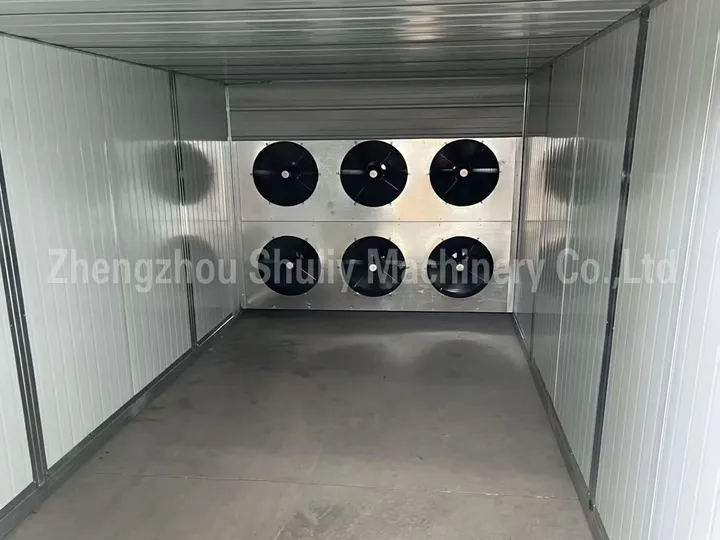
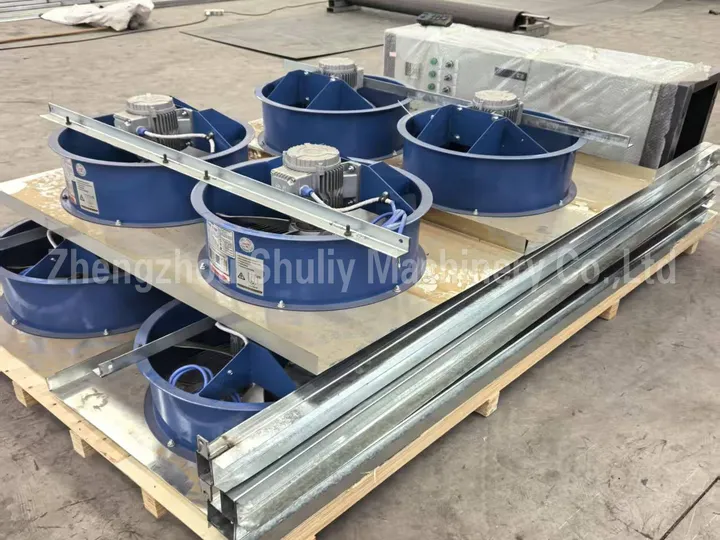
The air-source heat pump compressor extracts latent heat from ambient air. It recycles thermal energy from humid exhaust. The system achieves a COP of 3.0–4.0. Electricity costs drop by up to 70% compared to resistance-heated drying ovens. A 24 kW heat pump produces 72–96 kW of usable heat.
Precision Climate Control
PLC-driven PID algorithms control chamber temperature within ±1°C. Relative humidity stays within ±3%. Operators program multi-stage drying profiles through the HMI touchscreen. Each profile specifies temperature, humidity threshold, and fan speed for every drying phase.
360° Air Circulation
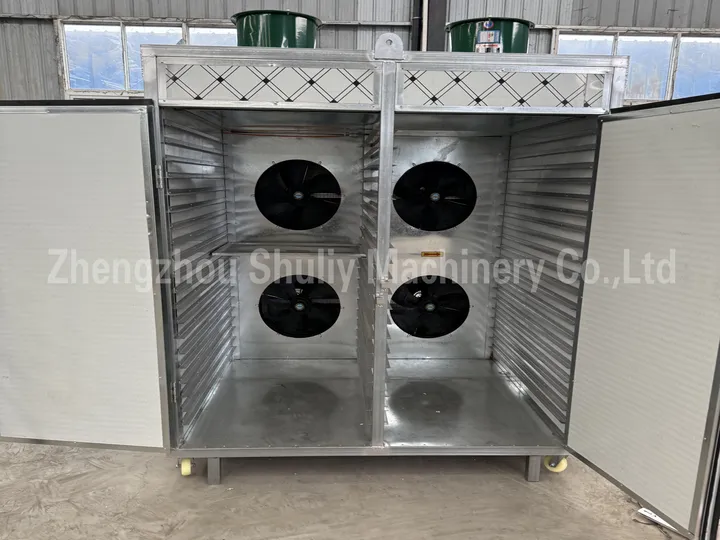
Multiple axial circulating fans create turbulent airflow across every tray layer. Hot spots are eliminated. Moisture extraction remains uniform. Perforated 304 stainless steel trays maximize air-lentil contact. Lentil loss through the perforations is prevented by 3 mm mesh holes.
Food-Grade Construction
The chamber interior, tray frames, and air ducts are fabricated from 304 stainless steel. The 75 mm rock wool insulation shell minimizes heat loss. Internal conditions remain stable regardless of ambient weather. The structure resists corrosion from organic residue.
Automated Moisture Management
Humidity sensors monitor internal vapor pressure in real time. Exhaust vents open automatically when relative humidity exceeds the set threshold. Drying speed accelerates during the falling-rate period. Re-condensation on cooler lentil surfaces is prevented.
Scalable Modular Design
Eight standard models cover 300–8,000 kg per batch. Custom configurations are available. A facility can start with one SL-4 unit and expand to a multi-chamber installation. Additional chambers share the same electrical and drainage infrastructure.
How Does the Heat Pump Lentil Dryer Work?
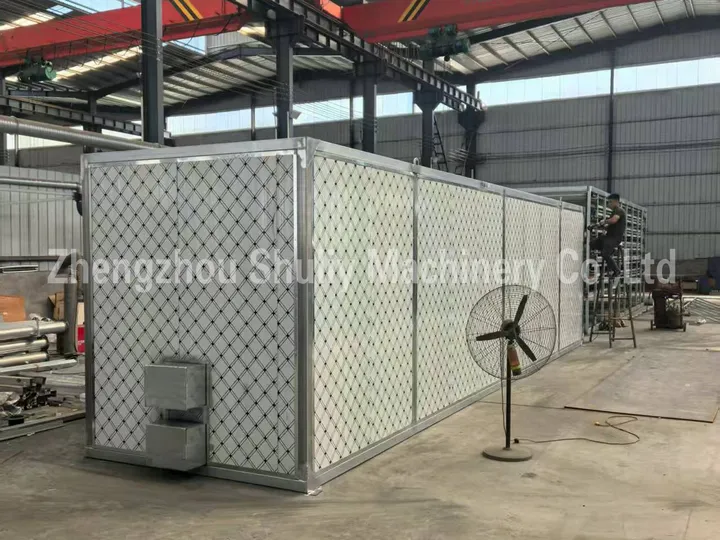
Các lentil drying machine operates on a closed-loop heat pump dehumidification cycle. No open flame is used. No direct high-temperature air contacts the lentils.
- Evaporation Stage: Ambient air passes across the evaporator coil. Refrigerant absorbs thermal energy. The air is pre-cooled.
- Compression Stage: The compressor raises refrigerant temperature and pressure. A high-grade heat source is created.
- Condensation Stage: Hot refrigerant circulates through the condenser coil inside the drying chamber. Circulated air heats to the setpoint temperature of 50–65°C.
- Dehumidification Stage: Warm, moist air passes over the evaporator coil. Water vapor condenses into liquid. The condensate drains from the system. The dry air is reheated and recirculated.
- Control Stage: PLC sensors monitor temperature, humidity, and airflow. Compressor speed, fan velocity, and exhaust damper position adjust in real time.
The energy-recovery design produces 3–4 kW of usable heat per 1 kW of electrical input. Conventional electric dryers produce only 1 kW of heat per 1 kW of input.
Lentil Drying Process: Step by Step
Optimal dried lentil quality requires disciplined process control at every stage.
Stage 1: Cleaning and Grading
Harvested lentils pass through a vibrating sieve. Dust, stones, and plant debris are removed. A gravity separator removes immature or damaged seeds. Clean lentils ensure uniform drying and prevent contamination.
Stage 2: Tray Loading
Operators distribute lentils in a uniform 3–5 cm layer across perforated 304 stainless steel trays. Overloading creates moisture gradients. Uneven spreading extends cycle time. Tray spacing allows unrestricted vertical airflow between layers.
Stage 3: Low-Temperature Drying
The heat pump dryer follows a two-phase profile:
- Main Drying Phase (55–65°C, 4–5 hours): Free moisture is removed from the lentil surface and interior. Humidity exhaust vents activate when relative humidity exceeds 60%.
- Final Conditioning Phase (50°C, 1–2 hours): Moisture equilibrates across the batch. Lentils approach the target 5% moisture level.
Stage 4: Cooling and Discharge
Moisture content reaches 5%. A digital moisture meter verifies the reading. Lentils discharge onto cooling conveyors or into ventilated bins. Rapid cooling to ambient temperature prevents condensation. Dried lentils are sealed in moisture-barrier bags. They transfer directly to storage silos, milling lines, or packaging stations.
Solving Common Lentil Drying Challenges
| Customer Pain Point | Giải pháp Shuliy | Result |
|---|---|---|
| Cracking from rapid moisture loss | Controlled drying at 50–65°C with ±1°C precision | Intact seed coat; whole lentil rate above 97% |
| Color fading from overheating | Heat pump drying at 70°C with automated exhaust | Green/red color retention above 95% |
| Mold and weevil infestation in storage | 5% final moisture with uniform batch drying | Storage stability extends to 24 months |
| Inconsistent splitting during milling | ±0.5% moisture deviation across the batch | Split lentil breakage rate drops below 3% |
| High electricity bills from resistance heaters | Heat pump COP 3.0–4.0 with energy recovery | 60–70% reduction in drying energy cost per kg |
| Seasonal harvest peaks overwhelming capacity | Modular SL-series from 300–8,000 kg; 6 h cycles | 3–4 batches per day; multi-chamber expansion available |
Why Choose Shuliy Lentil Drying Equipment?
- Proven Heat Pump Technology: Thousands of installed drying rooms across agricultural and food processing sectors. System reliability is validated in real-world conditions.
- Application-Specific Expertise: Drying protocols for lentils, chickpeas, and other pulses are pre-programmed into the PLC. Commissioning time is reduced. Operator training is simplified.
- Full Material Traceability: All stainless steel components carry mill test certificates. Chamber insulation meets fire-rating and thermal-conductivity standards for international export.
- Integrated Processing Lines: Shuliy supplies cleaning sieves, gravity separators, milling machines, and packaging systems. Turnkey lentil processing projects are supported.
- Global Export Experience: CE-certified electrical systems. Multi-voltage compatibility (220V/380V/415V/460V). ISPM- 15-compliant export packing ensures smooth customs clearance.
Frequently Asked Questions
What is the safe storage moisture content for dried lentils?
Lentils should be dried to 5–8% moisture for long-term storage. At 5% moisture, lentils can be stored for up to 24 months without mold growth or weevil infestation. Most international trade standards require moisture below 14%.
Can the lentil drying machine handle other types of pulses?
Yes. The same drying room processes chickpeas, black-eyed peas, kidney beans, mung beans, and pigeon peas. Each pulse type has a slightly different optimal temperature and drying time. These parameters are pre-programmed into the PLC and can be adjusted via the touchscreen.
How much electricity does a lentil dryer consume per batch?
An SL-6 model (800–1,500 kg/batch) consumes approximately 120–180 kWh per 6-hour drying cycle, depending on ambient temperature and initial lentil moisture. With the heat pump COP of 3.0–4.0, this translates to roughly $12–18 in electricity cost per batch at average industrial rates.
What happens if lentils are dried too quickly?
Rapid drying causes the outer seed coat to shrink faster than the interior. This creates micro-cracks. Cracked lentils cook unevenly. They also lose market value. The Shuliy lentil drying machine prevents this through gradual temperature ramping and controlled humidity exhaust.
Do I need to pre-clean lentils before loading them into the dryer?
Yes. Lentils should pass through a vibrating sieve and gravity separator before drying. Stones, dust, and plant debris reduce drying efficiency. They can also damage the stainless steel trays. Shuliy offers compatible cleaning equipment as part of a turnkey processing line.
Can the drying room be used for other agricultural products?
Yes. The same chamber dries grains, herbs, spices, dried fruits, tea leaves, tobacco, and medicinal materials. Temperature and humidity profiles are reprogrammed via the PLC touchscreen for each material type. The 30–80°C temperature range covers most agricultural drying applications.
What voltage options are available for export?
The lentil drying machine supports 220V, 380V, 415V, and 460V electrical systems. The PLC control panel is CE-certified. All electrical components meet IEC standards. Custom voltage configurations are available for specific country requirements.
Related Equipment
Continuous Conveyor Mesh Belt Dryer
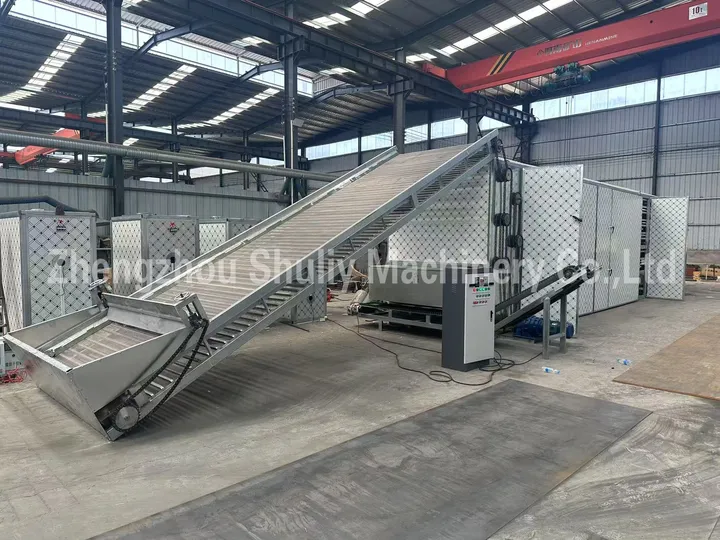
This multi-layer mesh belt drying machine has multiple standard models with hourly fresh material capacity from 60kg to 600kg and total power ranging from 11.4–36.8kW. It adopts a galvanized steel frame and 304 stainless steel mesh belt with 75mm thick high-temperature rock wool insulation, adjustable drying temperature of 50–140℃. Besides fruits and vegetables, it can dry medicinal herbs, seafood strips, granular charcoal and industrial raw materials. Equipped with a circulating hot air system, automatic moisture exhaust, and a stepless speed regulation device, it delivers evenly dehydrated finished products for food factories, herbal processing plants, and chemical manufacturers.
Core Advantages
- Wide Raw Material Compatibility: Fits flake, strip and granular permeable materials; adjustable material laying thickness of 10–80mm for different dehydration demands.
- Continuous Mass Production: Uninterrupted feeding and discharging workflow, only 2–3 operators required to greatly cut manual labor cost.
- Uniform Hot Air Circulation Design: Bottom-up penetrating hot air avoids local over-drying, stable finished product moisture and consistent appearance.
- Flexible Multi Heat Source Matching: Supports electricity, air source heat pump, natural gas, coal, biomass and steam to adapt regional energy conditions.
- Intelligent Automatic Control: Independent temperature & humidity regulation plus automatic dehumidification, stepless mesh belt speed for controllable drying duration.
- Durable Insulated Structure: Thickened heat preservation layer reduces heat loss; stainless steel conveyor belt is anti-corrosion and easy to clean.
- Complete Supporting Service: 12-month full machine warranty plus online & on-site technical guidance, customizable length, layers and production line layout.
Click the contact window on the right to get in touch with us. We will provide you with a quotation within 24 hours.